
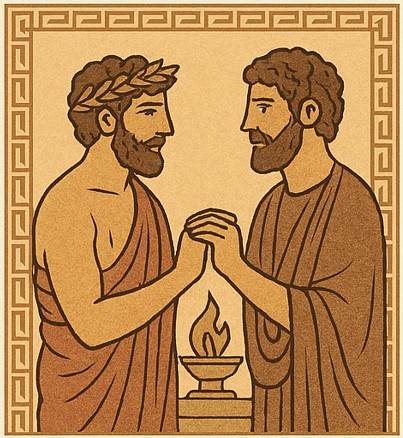
“In the old stories, love was not whispered — it was carried openly into the world, a flame bright enough to guide heroes through darkness. So it was with Iolaos and Heracles, two souls who walked side by side, sharing strength, sharing burdens, sharing the quiet knowledge that life is gentler when a trusted hand is always within reach. At the tomb of Iolaos, couples once pledged themselves to a love that asked for courage, for tenderness, for the promise to stand together through every season of their lives. Today, we honour that same spirit. May your love be a sanctuary — a place where each of you finds rest, and each of you finds fire. May you walk together as the Sacred Band once did, not in battle, but in harmony — each step a reminder that devotion is a choice, renewed day after day. And may your hearts, like theirs, be remembered not for the vows spoken here, but for the way you keep choosing one another in all the days still to come.”
Mark Inscoe
In the rich tapestry of ancient Greek culture, love between men was not merely acknowledged — it was honoured, ritualised, and woven into civic and military life. Among the most poignant traditions was the practice of male couples making sacred vows at the tomb of Iolaos, the beloved companion of Heracles. This ritual echoed powerfully in the story of the Sacred Band of Thebes, whose final stand at the Battle of Chaeronea in 338 BCE remains one of history’s most enduring symbols of devotion and courage.
The Mythic Heart: Iolaos and Heracles
Iolaos is remembered in Greek mythology as the devoted companion — and in some traditions, the lover — of Heracles. He stood beside the hero in battle, shared his trials, and became a symbol of loyal partnership in Theban culture. Though your search results did not include a direct source on Iolaos, his role is well established in classical literature.
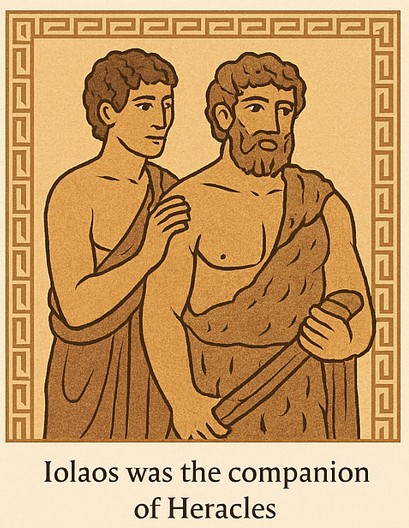
Sacred Vows at the Tomb of Iolaos
In Theban tradition, male couples would visit the tomb of Iolaos to swear vows of lifelong devotion. This was not marriage in the modern legal sense, but it was unmistakably a ritual of union, carrying spiritual and social significance. Couples chose this site for several reasons:
- Iolaos embodied the ideal of loving partnership: His bond with Heracles was celebrated as a model of loyalty and mutual support.
- Thebes embraced reciprocal unions: Theban culture emphasised equality and mutual respect.
- Love and heroism were intertwined: To bind oneself at the tomb of a hero was to declare that the relationship was publicly honourable.
- A sacred lineage of lovers: Each couple who made vows there joined a symbolic lineage of heroic male pairs.
The Sacred Band of Thebes: Love as Military Power
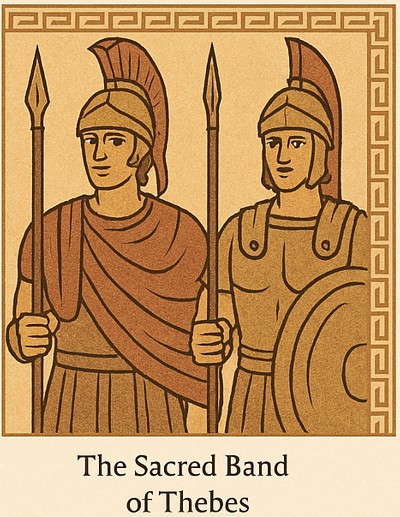
The most famous expression of Theban ideals was the Sacred Band, an elite military unit composed of 150 pairs of male lovers¹. Their reasoning was simple and profound: a man will fight more fiercely beside the one he loves — a belief echoed in Plato’s Symposium and reflected in Theban military policy². The Sacred Band became legendary for their discipline, unity, and courage, reshaping the balance of power in Greece.
The Battle of Chaeronea (338 BCE): A Tragic Testament
At Chaeronea, the Sacred Band made their final stand. Surrounded and outnumbered, they refused to retreat. When the battle ended, every member of the Band lay dead — not scattered, but fallen side by side, still forming a defensive line¹.
When Philip II surveyed the bodies, he is said to have wept, declaring: “Perish any man who suspects that these men either did or suffered anything unseemly.”¹
Their sacrifice became a symbol of the power of love — not as sentiment, but as a force capable of shaping history.

Legacy and Reflection
The tradition of making vows at the tomb of Iolaos and the story of the Sacred Band reveal a culture that understood something profound: love between men could be a source of honour, strength, and civic virtue. Thebes celebrated this truth openly. Their rituals, myths, and military institutions affirmed that such bonds were sacred, heroic, and foundational to the life of the city.
These stories offer a powerful reminder: the history of love is vast, diverse, and deeply human. Honouring it — in all its forms — is part of our craft, our calling, and our contribution to a more inclusive and resonant world.
Footnotes
- Wikipedia 2026, Sacred Band of Thebes, Wikimedia Foundation.
- Bennett, A. 2025, The Theban Elite Army of Lovers Who Defeated the Mighty Spartans, TheCollector, 11 July.
- History Skills 2026, The Sacred Band of Thebes: Elite Warriors of Ancient Greece.
A reading for a modern Gay Marriage, Commitment or Vow Renewal Ceremony
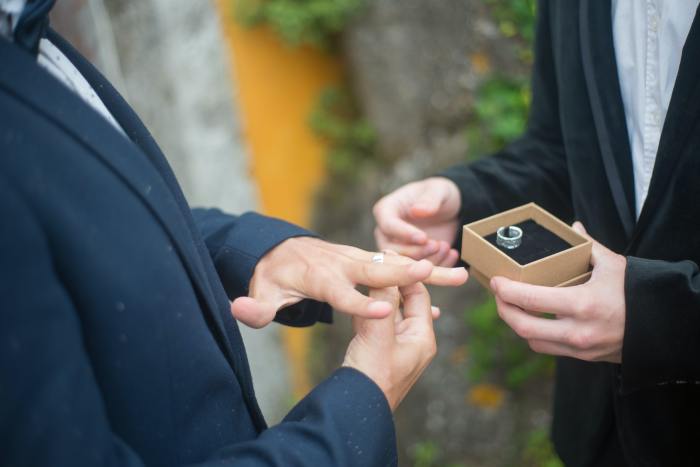
“In the stories of ancient Thebes, love was not a quiet thing. It was a force that shaped heroes, bound companions, and strengthened the very walls of the city. At the tomb of Iolaos, couples pledged themselves to one another — not for glory, but for the simple truth that life is braver when shared. Today, we honour that same spirit. May your partnership be a place of courage and tenderness. May you stand beside one another as the Sacred Band once stood — each a source of strength, each a shelter for the other. And may your love, like theirs, be remembered not for how it began, but for how fiercely it endured.”
